

2-Day Mt. Fuji Climbing Private Tour - Subashiri Trail
Forest to summit — climb through ancient woodland that most Mt. Fuji visitors never see.
The Subashiri Trail is Mt. Fuji's eastern approach and the only climbing route that begins in a living forest. Your ascent starts at 1,970 meters surrounded by birch, larch, and conifer woodland, climbing through one of the mountain's richest ecological zones before emerging above the treeline into volcanic terrain. The forest canopy here reaches 2,700 meters, the highest treeline on Mt. Fuji, giving you an experience of the mountain's living landscape that cannot be found on any other route.
Subashiri is a far less-traveled trail, which translates to a dramatically different mountain experience: quieter paths, available mountain huts, and the space to actually absorb what you're climbing through. For travelers who've already seen the crowded side of Japan's tourist infrastructure, this trail delivers the uncrowded authenticity you're seeking.
This tour suits a wide range of motivated climbers. Whether you're a seasoned trekker seeking a genuine mountain experience, a nature enthusiast drawn to the forest-to-summit transition, or someone who simply wants to climb Mt. Fuji without the crowds, Subashiri rewards your choice. You should be comfortable with 13–14 hours of total climbing time over two days and roughly 1,700 meters of elevation gain. Previous high-altitude experience is helpful but not essential.
Pacing, timing, and overnight arrangements adapt to your fitness level, weather conditions, and whether you prioritize a summit sunrise or a more relaxed schedule. We'll design the specifics together when planning your climb.



What this trail reveals
Forest zone ascent and the transition above it
Climb through Mt. Fuji's richest woodland — birch, larch, and conifers — with the mountain's highest treeline at 2,700 meters. Below that line: birdsong, filtered light, damp earth, and the sense that you're ascending through a living ecosystem rather than a barren slope. The transition out of the forest is gradual — trees thin, shrink, and the trail weaves between stretches of canopy and open sky. On Subashiri's eastern slope, the vegetation reaches upward wherever it can hold, so the boundary isn't a clean line but a slow farewell to the forest. By the time you're fully above it, looking back down into the green canopy you've been climbing through, you realize the mountain has completely changed character around you.
Kage Fuji shadow phenomenon
In late afternoon, Mt. Fuji casts its own enormous triangular shadow eastward across the landscape far below — a phenomenon called Kage Fuji. The Subashiri side faces directly into it, so when conditions align, you watch the mountain's silhouette stretch toward the horizon as the sun drops behind you. It appears most sharply on days with clean atmosphere or when the shadow is cast across a sea of low clouds below — the mountain's dark triangle projected onto white. You may catch it while still ascending on the trail or from the mountain hut after the first day's climb is complete.
Subashiri Tainai lava cave
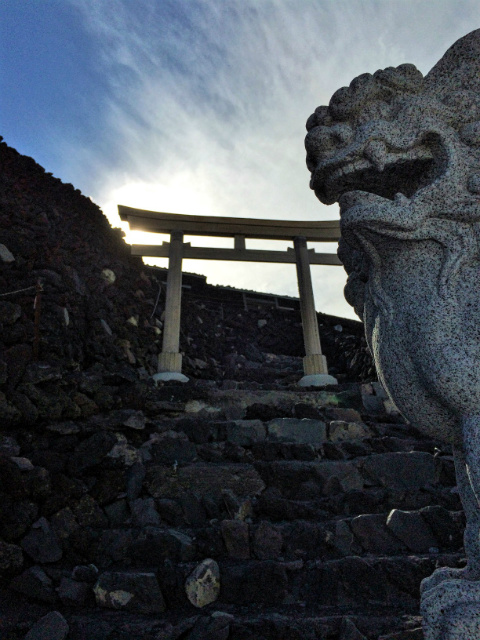
A small volcanic cave and shrine along the trail where Fujiko pilgrims once performed ritual rebirth ceremonies — entering the dark interior of the mountain and emerging back into light as a form of spiritual purification. The cave is low and narrow; you duck inside and the daylight disappears for a moment. It lasts only a minute, but it connects you to the centuries of worship that shaped every trail on this mountain.
Sunrise from the mountain hut
Watch the sun rise over the horizon from your mountain hut. Subashiri's due-east position gives it the best sunrise angle of any Mt. Fuji trail, with unobstructed views from anywhere above the treeline. By enjoying sunrise at the hut and departing after breakfast in full daylight, you climb the upper mountain when the trail is at its quietest. This matters on Subashiri because the trail merges with the busy Yoshida route near the summit. By starting later than the sunrise crowd, you avoid the congestion entirely. The result: a quieter final ascent and a quieter summit. Your descent splits away from Yoshida back onto empty Subashiri trail.
Sunabashiri volcanic gravel descent
After summiting, descend the famous 3-kilometer Sunabashiri gravel-running slope — sliding through soft volcanic ash in long, bounding strides. It takes some trust to lean into the technique: you're essentially controlled-falling down the mountain, each step sinking ankle-deep into gravel. I demonstrate the stride before we start and advise caution throughout. The descent is steep and long, and your knees take real punishment if you push the pace. Subashiri's sand run is the full descent experience: three kilometers of open volcanic slope from above the treeline back down to the forest.
Tour details
Private tour (single booking) for up to 5 persons
Season: Early July (early summer) through early September (early fall) — dates coordinated around weather
Duration: 2 days / 1 night (overnight at mountain hut)
Starts/Ends: Subashiri Trail 5th Station in Oyama town, Shizuoka
Elevation: 1,970m (5th Station) to 3,710m (summit) — approx. 1,700m gain
Physical Level: Strenuous — 13–14 hours total climbing over 2 days; requires good fitness and endurance
Price: From JPY 235,000/tour
Included:
Guiding by a licensed local Mt. Fuji climbing guide
Personal consultation and support for tour/travel planning and preparation in each stage: pre-, in-, post-tour
Not Included:
Lodging and meals charges (Fujisan Curator will book a mountain hut for you on your behalf)
Mountain entry/climbing fee
Miscellaneous personal expenses such as use of toilet, food, drink, and souvenirs
Transportation to/from tour start/end location (transport can be arranged)
Specific mountain hut selection and tour schedule/timing are adjusted based on your climbing dates, conditions, and pace.
Why this tour
The only forest climb on Mt. Fuji.
Every other trail begins above the treeline in barren volcanic terrain. Subashiri alone gives you a living mountain — woodland, birdsong, filtered light — before the volcanic landscape above. If you want to understand Mt. Fuji as an ecosystem rather than just a summit, this is the trail.
Genuine solitude without extreme demand.
Subashiri receives over 80% fewer climbers than Mt. Fuji's popular trails, but the physical demand is moderate by climbing standards — comparable to other summit routes, with the forest zone providing shade and shelter during the lower ascent. You get the uncrowded experience without needing the fitness level that the Gotemba trail's 2,300m elevation gain demands.
Weather-optimized flexible scheduling.
Your climbing dates are coordinated within a flexible window using professional mountain weather forecasting. This approach ensures you experience the mountain in the best available conditions rather than gambling on fixed dates — a difference that matters significantly at 3,776 meters.
A local guide who reads this trail.
The forest zone ecology, the Tainai cave's pilgrimage significance, the timing strategy that avoids the Yoshida merge congestion near the summit — these are details that come from years of guiding this specific trail, not from a guidebook. I interpret the mountain as we climb, and you experience it with context that an independent climb cannot provide.
Explore my Mt. Fuji climbing tours
Fujisan Curator offers three climbing experiences on Mt. Fuji's less-traveled trails — each with its own character.
Subashiri Trail
Forest to summit
2-day · ~1,700m gain
You are herePrince Route (Gotemba)
Volcanic crater traverse
2-day · ~1,300m gain
Ohachimeguri
Sacred summit circuit
Add-on · ~2 hrs at summit
Not sure which suits you? See my Mt. Fuji Climbing Tours overview for a comparison of all options.
Ready to Climb Subashiri?
Send your inquiry with preferred dates and any questions. I'll respond within 24 hours with availability, scheduling recommendations, and next steps for planning your climb.
As part of the planning process, I offer a free 30-minute video consultation to discuss your climb in detail — trail conditions, weather strategy, fitness preparation, and anything else you'd like to know from someone who actively guides these trails.