
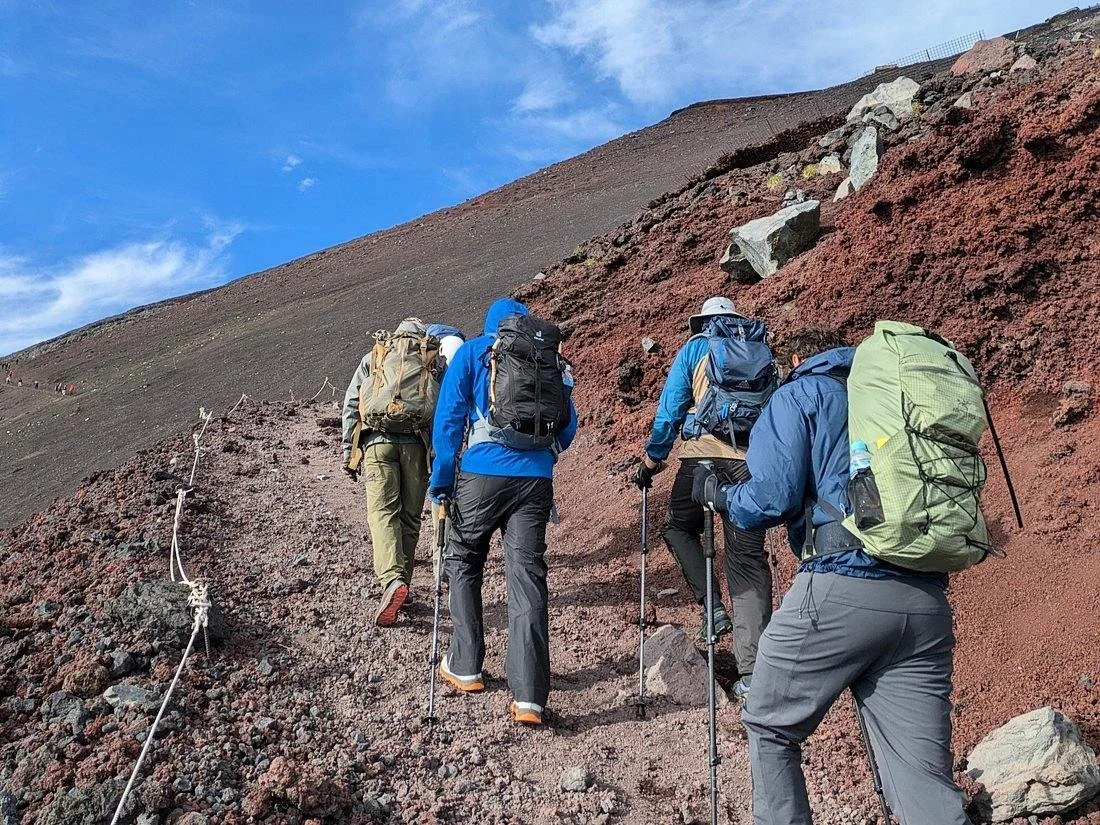
The ground tells you first.
Before the altitude, before the weather, before the view from the summit — the ground under your boots tells you where you are. Fine volcanic gravel at the lower stations gives way to loose debris, then fractured stones, then raw rock as you climb higher. The mountain becomes more rugged with every hundred meters of elevation. By the time you're above 3,000 meters, you're walking on the exposed skeleton of an active stratovolcano — and it feels exactly like that.
I've been guiding climbers on Mt. Fuji for years, and this is usually the first thing I point out: you're not on a hiking trail. You're on a volcano. Everything about this mountain — what you see, what you feel underfoot, how the weather behaves, why certain trails exist and others don't — follows from that single fact.
Most people arrive with a different picture in their heads.
The Mountain People Imagine vs. the Mountain That's Actually There
The image most people carry of Mt. Fuji is the perfect symmetrical cone, snow-capped, seen from a distance. It's one of the most recognizable silhouettes on Earth. But that view tells you almost nothing about what it's like to be on the mountain.
At the summit of Japan's highest peak, there's a post office. There are vending machines. Shrines where Shinto priests work through the climbing season. People queue for photographs at the marker stone. This is one version of Mt. Fuji — the version most climbers experience, because most take the same trail to the same point at the same time.
But scattered around that same summit, and along the climbing trails leading to it, are stone markers, ruined shrine gates, and other remnants of something older. For centuries, climbing Mt. Fuji was not recreation. It was tōhai — pilgrimage climbing. The practice was rooted in Fuji worship and carried a specific meaning: ascending from the everyday world into the realm of death, and returning, to cleanse the sins and impurities of this life. The mountain was structured for this purpose — stations, rituals, routes — all designed around a spiritual journey, not a physical challenge.
This surprises even clients who've climbed extensively elsewhere. People who've summited in the Alps or on Kilimanjaro arrive expecting a volcanic peak with good infrastructure. What they don't expect is a mountain where the climbing route itself is a centuries-old sacred geography — where the trail's purpose was never just to get you to the top. Most English-language climbing guides never mention this. But once you know it, you see the mountain differently. The shrines at the summit aren't tourist additions. They're the reason the trails exist.
And then there's the weather.
If I had to name the single factor that shapes a Mt. Fuji climb more than anything else, it isn't fitness. It isn't trail choice. It's weather — specifically, wind. On the exposed ridgelines above the treeline, with nothing to block it, strong wind can make it impossible to walk safely. I monitor forecasts carefully and sometimes adjust routes or schedules in advance. But forecasts aren't certainties at 3,500 meters. There are moments when you encounter conditions on the mountain that require an immediate decision: continue, take shelter, or change course. Reading those conditions in real time — and having the experience to act on them — is the part of guiding that no itinerary can capture in advance.
Weather determines more about the quality of a Mt. Fuji climb than preparation or equipment. A clear day on the upper mountain is an entirely different experience from a cloud-wrapped one. This is why, when I plan a two-day climb, my priority is getting Day 2 in the best possible weather. Day 2 is longer — the final push to the summit, the crater circuit if conditions allow, and the full descent — and it's the day that shapes whether the climb becomes a lasting memory or just a physical effort you're glad is over.
What Different People Find on This Mountain
I guide people across a wide range of experience. Some have climbed on four or five continents. Others have never been above 1,000 meters. What I've learned from guiding both is that Mt. Fuji meets each of them differently — and not always in the ways they expect.
For experienced mountain travelers, the altitude itself isn't the draw. Japan's highest peak tops out at 3,776 meters — modest compared to many mountains they've already climbed. What catches their attention is the combination: an active stratovolcano with its own weather systems, unique volcanic vegetation, and a sacred geography layered on top of the geological one. No other mountain offers quite this mix. These clients tend to notice the details — the way rock composition shifts with altitude, the abruptness of ecological transitions on certain trails, the religious artifacts along the route that most climbers walk past without registering. For them, a guide's value lies in interpretation: pointing out what they're looking at and what it means.
For first-time high-altitude climbers, the mountain presents a more immediate reality. Altitude sickness is common, and it's unpredictable — how symptoms appear varies from person to person, and many people can't tell whether what they're feeling is altitude-related or simply fatigue. As a guide, I watch for signs that clients themselves may not recognize, adjusting pace and rest timing accordingly. But beyond the physical, there's usually a moment somewhere on the ascent when the climb shifts from something they're doing to something they're experiencing. It doesn't happen at the same point for everyone. Sometimes it's crossing above the treeline and seeing the landscape open up beneath them. Sometimes it's looking up at the crater wall from inside Hoei Crater and realizing the scale of what they're standing inside. When it happens, you can see it in how they move, how they look around. That shift is what makes guiding this mountain worthwhile.
Groups add another layer. When a family or group of friends climbs together, the members almost always spread apart as the day goes on. The faster climbers move ahead; the slower ones fall behind. Trying to keep everyone at the same pace usually means the slowest person sets the tempo, which frustrates those who are comfortable moving faster. In practice, I let the group find its natural distribution within limits I can manage, adjusting in real time as each person's actual climbing ability reveals itself — which is often different from what anyone predicted before the climb. The care I take with slower members isn't just physical pacing. It's easing the mental stress of feeling like you're holding people back. That attention matters as much as any logistical decision.
What Shapes Your Experience
Three things determine what kind of Mt. Fuji climb you have. None of them appear in the standard comparison charts.
The trail you choose determines what kind of mountain you meet.
Mt. Fuji has four official climbing trails and several alternate routings between them. They deliver fundamentally different experiences — not just different difficulty levels. Some pass through forest before breaking above the treeline. Others cross open volcanic terrain from the start. One route traverses the interior of a crater left by the mountain's last major eruption. The most popular trail offers mountain huts and infrastructure at close intervals; the quietest can go hours without seeing another climbing party. The character of your climb — what you see, what the terrain feels like, how many other climbers surround you — depends almost entirely on which route you take. I guide on two of the quieter trails, with an optional summit crater circuit.
When you climb matters as much as where you climb.
The same trail on a Tuesday in early July and on a Saturday during the Obon holiday in mid-August will feel like two different mountains. Crowd density, weather patterns, mountain hut availability, and even the condition of the trail surface change across the season. Scheduling a climb to align with the best available conditions is one of the most consequential decisions in the planning process — and one of the hardest to make without local knowledge.
What you notice along the way depends on who you're climbing with.
This is something I hear consistently from clients who have climbed Mt. Fuji before — usually via the Yoshida Trail, either independently or with a large group tour. They describe their previous climb as getting to the summit and back: the ascent and descent were essentially painful movement between the start and the goal. The mountain was an obstacle to endure, not a place to understand.
With a guide providing interpretation throughout the climb — the geology of what you're walking on, the ecology of the zones you pass through, the sacred history embedded in the trail, the weather patterns visible from the ridge — the same mountain becomes something else entirely. The ascent has texture. The summit has context. The descent has its own character. The whole journey becomes a coherent experience rather than a physical transaction with a summit photo as the receipt.
I don't say this to argue that everyone needs a guide on Mt. Fuji. The Yoshida Trail is well-marked and well-supported, and thousands of people climb it safely each season without one. But on the quieter trails where I guide — where there are fewer markers, fewer huts, fewer other climbers, and more of the mountain's volcanic and cultural character is visible — having someone who reads the weather, knows the terrain, and can tell you what you're looking at changes what the climb is, not just how smoothly it goes.
The Question That Matters
Most Mt. Fuji climbing guides try to answer the question: Can I do this?
It's a reasonable question. But it's not the most useful one.
The question that actually shapes your experience is: What kind of Mt. Fuji climb am I looking for?
The answer is different for everyone. Some people want the summit and the sunrise — the iconic experience, shared with hundreds of other climbers. That's a valid goal, and there's a trail built for it. Others want something quieter — a volcanic landscape most climbers never see, a route with space to notice what you're walking through, a guide who knows this mountain well enough to show you what makes it unlike any other.
Mt. Fuji is Japan's highest mountain, an active stratovolcano, a centuries-old pilgrimage route, and a UNESCO World Cultural Heritage site. These layers don't reveal themselves from the summit marker. They reveal themselves along the way — if you're on a trail where they're visible, and if someone is there to point them out.
If you're thinking about what kind of climb you want, I'm happy to discuss it. Schedule a free consultation.
You can also explore the climbing tours I offer — two trails, each showing a different face of this mountain, with an optional summit crater circuit for those who want to go further. See the Summit Paths climbing tours.